Snow Load and Ice Dams: A Guide for Alaska Homes
What your roof was built to carry, how to estimate the snow on it, and how to clear it without climbing up. Then what causes ice dams, attic frost, and slides, and what reduces them.
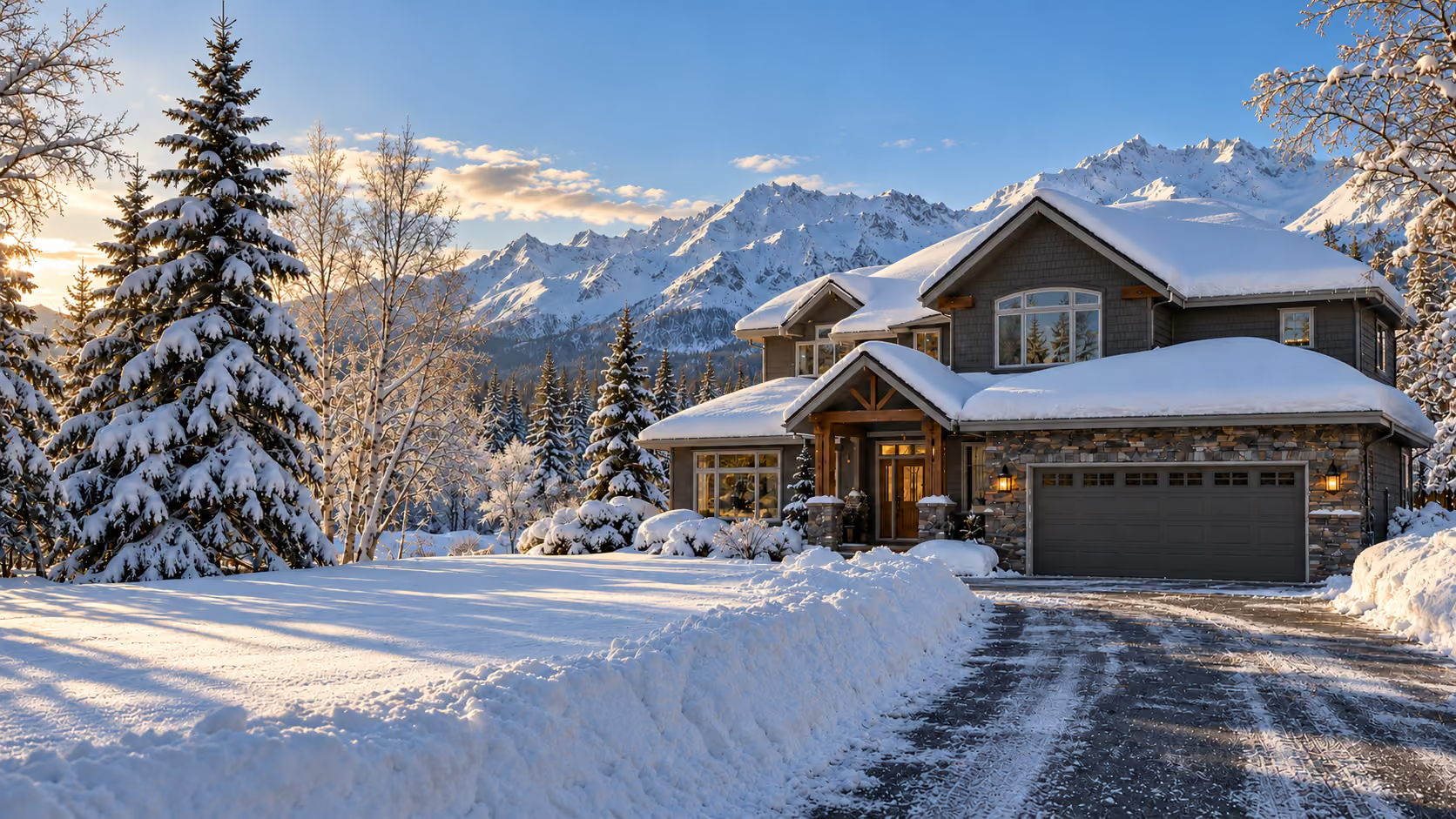
Snow load is the weight of snow and ice a roof has to carry. In Anchorage, the Municipality has said most homes should be able to safely support the 40 psf (pounds per square foot) design load, and the roofs that failed in the heavy winters of 2022-23 and 2023-24 were almost all commercial.
Drifts, ice, and older or unpermitted framing are where the trouble starts. This guide covers what to know in Anchorage, the Mat-Su, Girdwood, and Fairbanks.
The short version
- Weight, not depth. A foot of fresh snow can weigh 3 to 21 psf, depending on how wet it is.
- Know the warning signs. Popping, sagging, doors that won’t open or close: get everyone out of the building, then call.
- Rake from the ground. Leave at least 2 inches on the roof, and keep the rake away from power lines.
- Ice dams start in the attic. Air sealing and insulation do most of the work.
- Slides are a hazard. Snow guards hold snow over doors and walkways. Without them, block off the area below.
How much snow your roof is built for
Codes list a ground snow load, a roof snow load, or both, and the two aren’t the same number:
- Anchorage and Eagle River. Houses are designed for a 50 psf ground snow load under the 2024 code. The Municipality’s snow guidance puts the minimum roof design load at 40 psf, roughly 2 feet of dense, wind-worked snow. Its posted design data adds 7 psf per 100 feet above 500 feet on the Hillside.
- Girdwood. The same posted data lists 140 psf on the ground up to 300 feet, nearly three times Anchorage’s, and calls for a site-specific study above that. Roofing in Girdwood →
- Palmer. City code sets a 50 psf roof snow load. Roofing in Palmer →
- Wasilla, Big Lake, and the borough outside the cities. No residential building code, so no local snow load is set for houses.
- Fairbanks and North Pole. Both cities’ codes set a 50 psf roof snow load, and Fairbanks lists 60 psf on the ground. Homes built before the early 1990s were designed for 40 psf, some for less. Outside city limits, there’s no building code for houses. Roofing in Fairbanks →
What snow weighs, and a quick estimate
Depth alone won’t tell you: FEMA puts a foot of fresh snow anywhere from 3 psf, light and dry, to 21 psf, wet and heavy. A rule of thumb from federal building guidance:
- Fresh snow. 10 to 12 inches is about 1 inch of water, or about 5 psf.
- Old, settled snow. 3 to 5 inches is about the same 5 psf.
- Ice. A little under 5 psf an inch. Eight inches of ice comes close to Anchorage’s 40 psf minimum.
- Water. Multiply the inches of water in the snow by 5.2, the City of Fairbanks formula.
By that math, 2 feet of old snow weighs about 24 to 40 psf, and the Cold Climate Housing Research Center (CCHRC) notes that 30 to 35 psf can bring some roofs down. Drifts and valleys carry more than the rest of the roof.
Warning signs of too much snow
FEMA lists these signs of an overloaded roof:
- Sounds. Popping, cracking, and creaking.
- Sagging. A roof line that sags, or trusses that bow.
- Doors and windows. Ones that can no longer open or close.
- Cracks. Cracks showing up in walls or masonry.
- Leaks. Severe roof leaks.
If you see any of them, get everyone out of the building, then call. FEMA also says to stop any snow removal and contact a qualified design professional, such as a structural engineer. From Girdwood to Big Lake, call us at (907) 701-2233, emergencies included.
Clearing snow safely from the ground
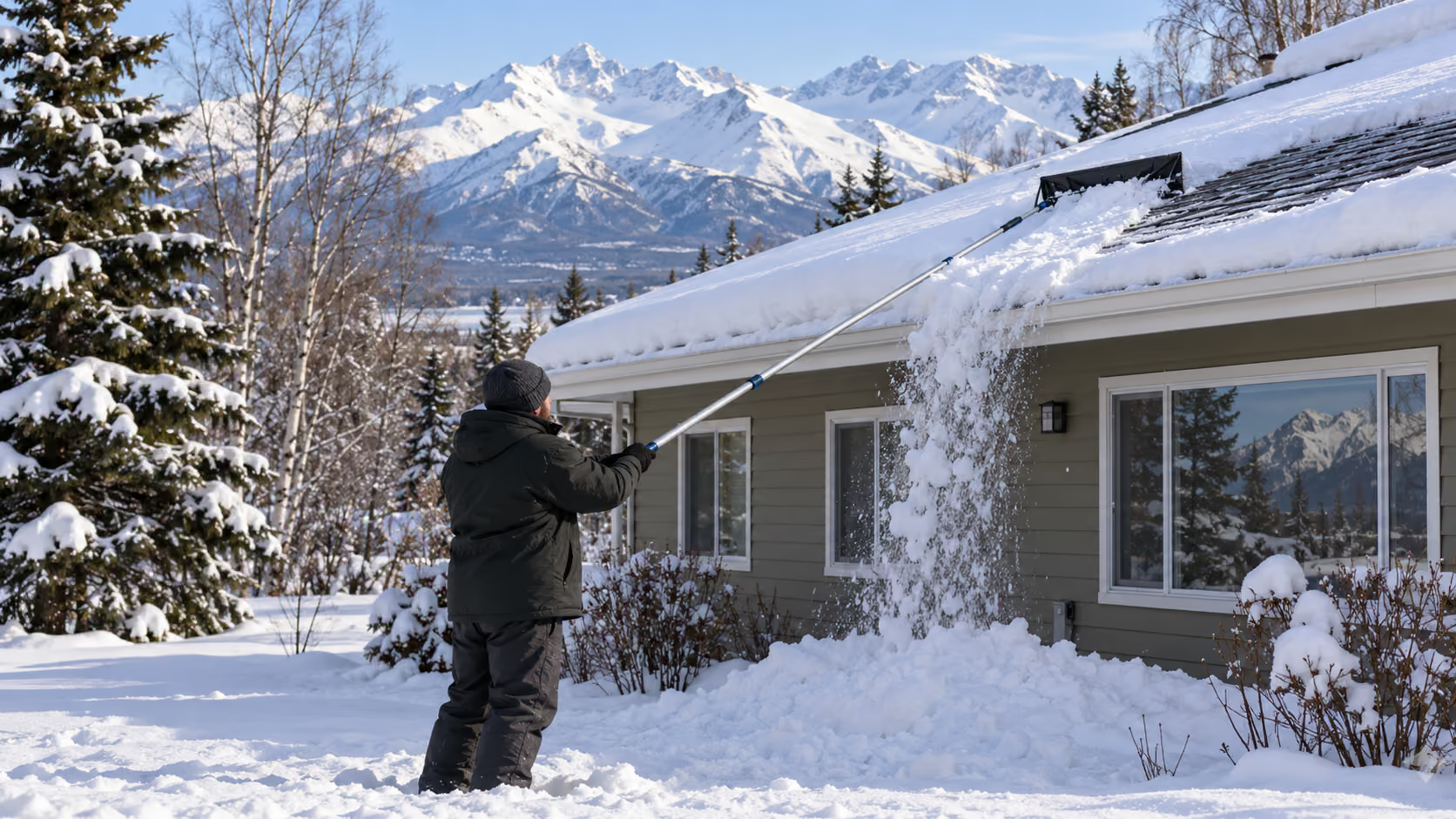
Clear from the ground. FEMA notes that working from there removes the risk to people on a hazardous roof.
- Use a roof rake. Pull snow off the lower part of the roof from the yard. FEMA suggests a non-metallic rake for steep roofs if possible.
- Stay off the roof. If you can’t reach the snow from the ground, Anchorage’s snow guidance recommends a licensed roofing company, because working up high is hazardous.
- Mind the power line. An aluminum rake conducts electricity. Alaska OSHA says to stay at least 10 feet from any power line.
- Leave a layer. FEMA says to leave at least 2 inches and use plastic tools, not metal. Scraping down to bare roofing risks serious damage.
- Drifts and valleys first. They carry the most. Engineers suspect a drift about 3 feet deep brought down part of the Palmer Public Library’s roof in 2023.
- Stand clear. Keep yourself, kids, and pets out from under the snow as it comes down.
Flat roofs are harder: most of one is out of reach, and FEMA notes meltwater pools in low spots when drains are blocked. Anchorage’s recent failures were mostly older flat commercial roofs on wood trusses, and for that type, built before 1995, a Municipality letter advised keeping snow under 15 psf. Flat roofing →
Not sure how much is up there?
Text us a photo of the roof from the yard, and a roofer will tell you what we see.
When to hire roof snow removal
Get help when the snow is out of reach, drifts are building, your estimate nears what the roof was built for, or ice is forming at the eaves. Call sooner for an older house, anything built without a permit, or a mobile home, which CCHRC notes can be built to carry just 20 psf.
We clear snow from homes and flat commercial roofs from Girdwood to Big Lake, but not in Fairbanks, where our work is planned trips for replacements, metal roofs, and inspections. There, hire a professional contractor, as CCHRC advises. Roof snow removal →
What causes ice dams
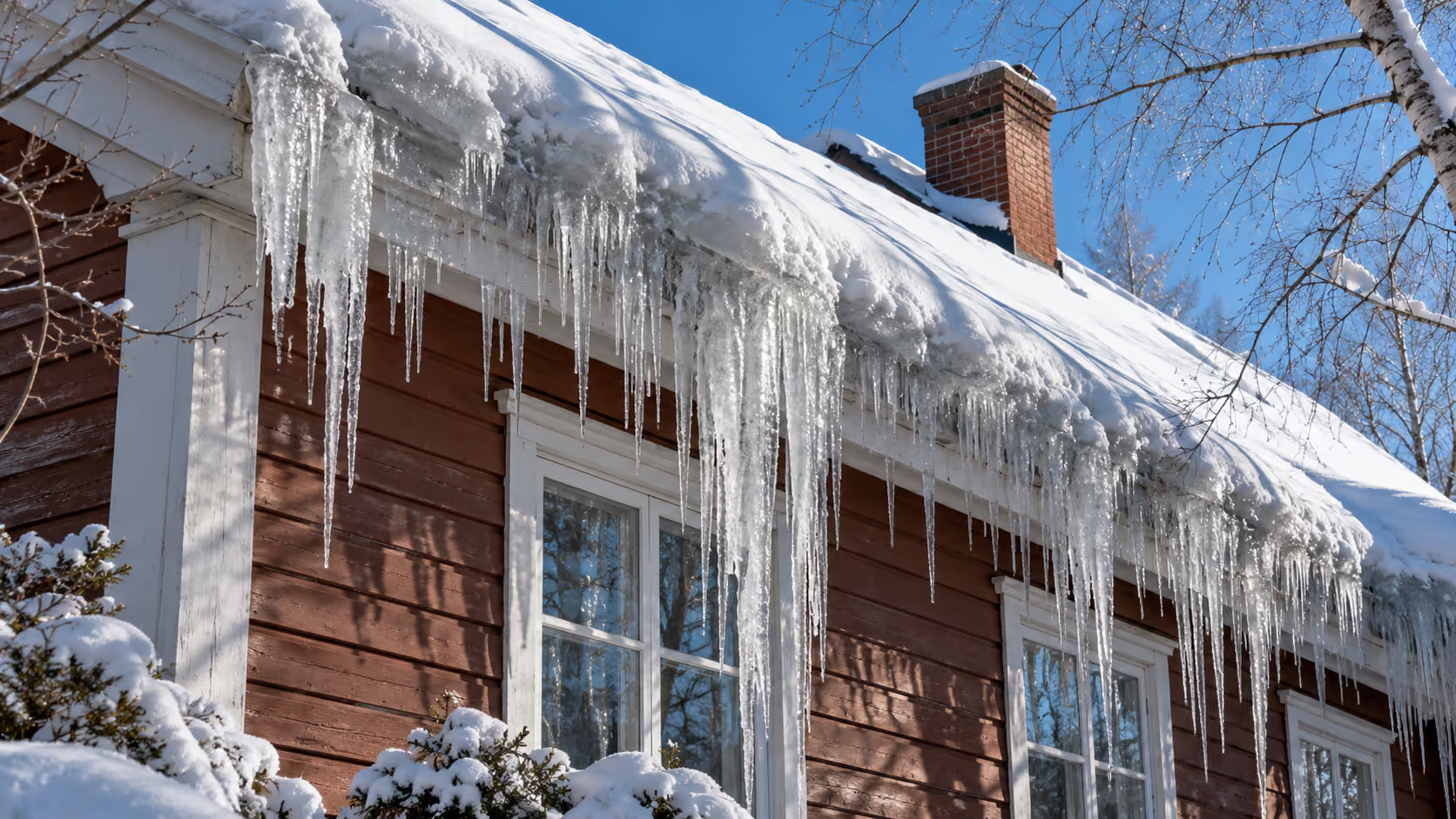
Heat from the house warms the roof deck. The snow on it melts, and the water runs down to the cold edge of the roof and freezes. That ice holds back the next melt, which can work its way into the roof and walls.
Fairbanks gets them too. CCHRC calls them a relatively common sight there in midwinter, caused by air leaking from the house into the roof, too little insulation, or not enough ventilation.
What actually reduces ice dams
Get the snow off
Clearing snow before it melts and refreezes takes away what feeds the dam, but the Municipality says clearing just the eaves typically isn’t enough. Heat cable only treats the symptom.
Keep the heat in
Seal the ceiling airtight first, then insulate on top. Heat carried up by leaking air is a far bigger concern than heat moving through insulation, so air sealing and insulation do most of the work.
- Ventilation. Vents at the eaves and near the ridge flush away heat that still reaches the deck, which keeps it cold and cuts down on ice dams. Attic ventilation →
- Ice and water membrane. It limits the damage when a dam forms but doesn’t prevent one. Anchorage’s code runs it at least 36 inches inside the exterior wall on slopes of 4 in 12 and up, and over the whole roof below that. Ice dam prevention →
Frost in the attic
Frost on the underside of the roof deck is water vapor from the house that condensed there. In almost all cases, CCHRC says, warm, moist indoor air is rising and escaping through leaks in the ceiling.
- Where it gets in. Around chimneys, bath and dryer ducts, ceiling light fixtures, holes in the vapor barrier, and bath fans that don’t vent outside.
- What it means. The same leaks feed ice dams. Heavy frost on vents can mean moisture damage, and staining can point to a long-term problem.
- What to do. A blower door test with an infrared scan finds the leaks. Seal them before adding insulation.
Our free inspection goes into the attic, and frost is one of the things we photograph. Roof inspections →
Icicles and snow slides
Snow and ice coming off a roof is a hazard. Falling snow and ice have killed people in Anchorage, and a slide can hurt people and pets, crush a deck, an AC unit, or a car, and tear the gutters off.
FEMA notes that any sloped roof without snow guards can slide, shingle roofs included. Standing seam lets go fastest. Stone-coated steel holds snow in place much like a shingle roof and usually lets go in smaller slides, not a whole slope at once.
- Snow guards. They hold snow on the roof. Standing seam gets them wherever a slide would land, and stone-coated steel still gets them over doors, decks, and walkways. Snow guards →
- No guards yet? Below a metal roof, Anchorage’s snow guidance says to block access to the area.
- Icicles. Over a door or path, block off the area under them, or have a roofer take them down. Big icicles are also a classic sign of an ice dam.
Heavy roof, or ice at the eaves?
Text us a photo, or book a free roof and attic inspection, with a photo report and a written price within 24 hours.
Questions about snow on your roof
What Alaska homeowners ask us most every winter. Don’t see yours? Text us and a roofer answers.
Text my rooferHouses in Anchorage are designed for a 50 psf ground snow load under the 2024 code, and the Municipality’s snow guidance puts the minimum roof design load at 40 psf, roughly 2 feet of dense, wind-worked snow. The Municipality has said most homes should be able to safely support 40 psf, and buildings built after 1990 well over it.
It depends on how wet and settled it is. FEMA puts a foot of fresh snow anywhere from 3 psf, light and dry, to 21 psf, wet and heavy. By a common rule of thumb, 10 to 12 inches of new snow or 3 to 5 inches of old snow is about 5 psf, and ice a little under 5 psf per inch.
FEMA’s warning signs include popping, cracking, or creaking, a sagging roof line or bowing trusses, doors or windows that no longer open or close, cracks in walls, and severe leaks. If you see any of them, get everyone out of the building, then call.
Not from up there. Clear what you can from the ground with a roof rake, leave at least 2 inches on the roof, and keep the rake at least 10 feet from power lines. If you can’t reach it from the ground, the Municipality of Anchorage recommends a licensed roofing company, because working up high is hazardous.
Heat leaking from the house warms the roof deck and melts the snow on it, and the water refreezes at the cold eaves, holding back more melt that can leak into the roof and walls. Air sealing and insulation do most of the work to stop it, ventilation cuts down on the rest, and membrane at the eaves limits the damage.
It’s water vapor from the house that condensed on the underside of the roof. CCHRC says that in almost all cases, moist indoor air is escaping through the ceiling, often around chimneys, bath and dryer ducts, light fixtures, or bath fans that don’t vent outside. Heavy frost on roof vents can mean moisture damage. Seal the leaks before adding insulation.
Let’s look at your roof and attic
Text us a photo, or book a free inspection of the roof and the attic. You get a photo report and a written price within 24 hours of the inspection.