Filing a Storm Damage Roof Claim in Alaska
Wind, snow load, or a falling tree can turn a roof into an insurance claim overnight. Here’s what to do first, who to call, and how the claim works in Alaska.
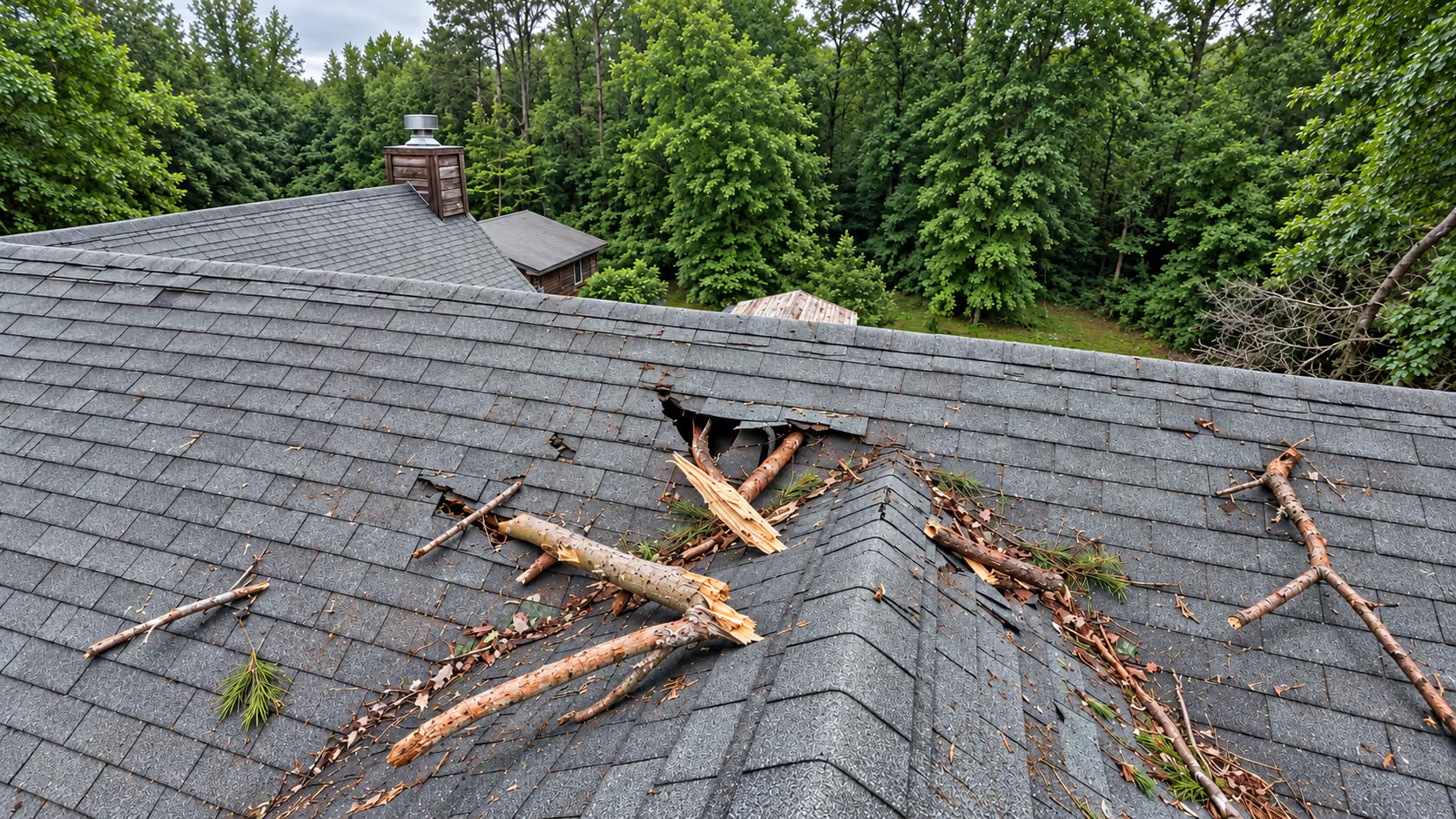
A Chugach wind strips shingles off the ridge. A spruce comes down across the roof. A heavy snow year piles on weight until a ceiling cracks. Any of these can turn into an insurance claim, and what you do in the first few days shapes how it goes.
Here’s how a roof claim works in Alaska: the first steps, who to call, the adjuster’s visit, how the money arrives, the deadlines insurers must meet, and what to do when the answer comes up short. Your policy and your adjuster decide what’s covered. You file the claim, and it stays yours.
The short version
- Stay safe. Off the roof, and out of any building with a sagging ceiling.
- Photograph it. Before any cleanup or repairs.
- Stop further damage. A temporary fix if it’s safe, with receipts.
- Report it promptly. As soon as you know there’s damage.
- Get it inspected. Free, on the roof and in the attic.
First steps after the damage
- Stay off the roof. If a ceiling sags under snow, get everyone out of the building, then call.
- Document it. Photos before any cleanup or repairs, the storm’s date, and a record of every contact with your adjuster. Keep damaged property, too, so your insurer can inspect it.
- Stop further damage. If it’s safe, Alaska’s Division of Insurance says to make temporary repairs and keep the receipts. Catch the water inside, and leave covering the roof to a roofer. Emergency roof repair →
- Hold off on permanent repairs. Your insurer may not pay for repairs it didn’t authorize, the Division warns.
Insurer or roofer first?
If you can see damage, like a tree through the roof, call your insurer or agent right away. Alaska’s Division of Insurance lists that as the first step.
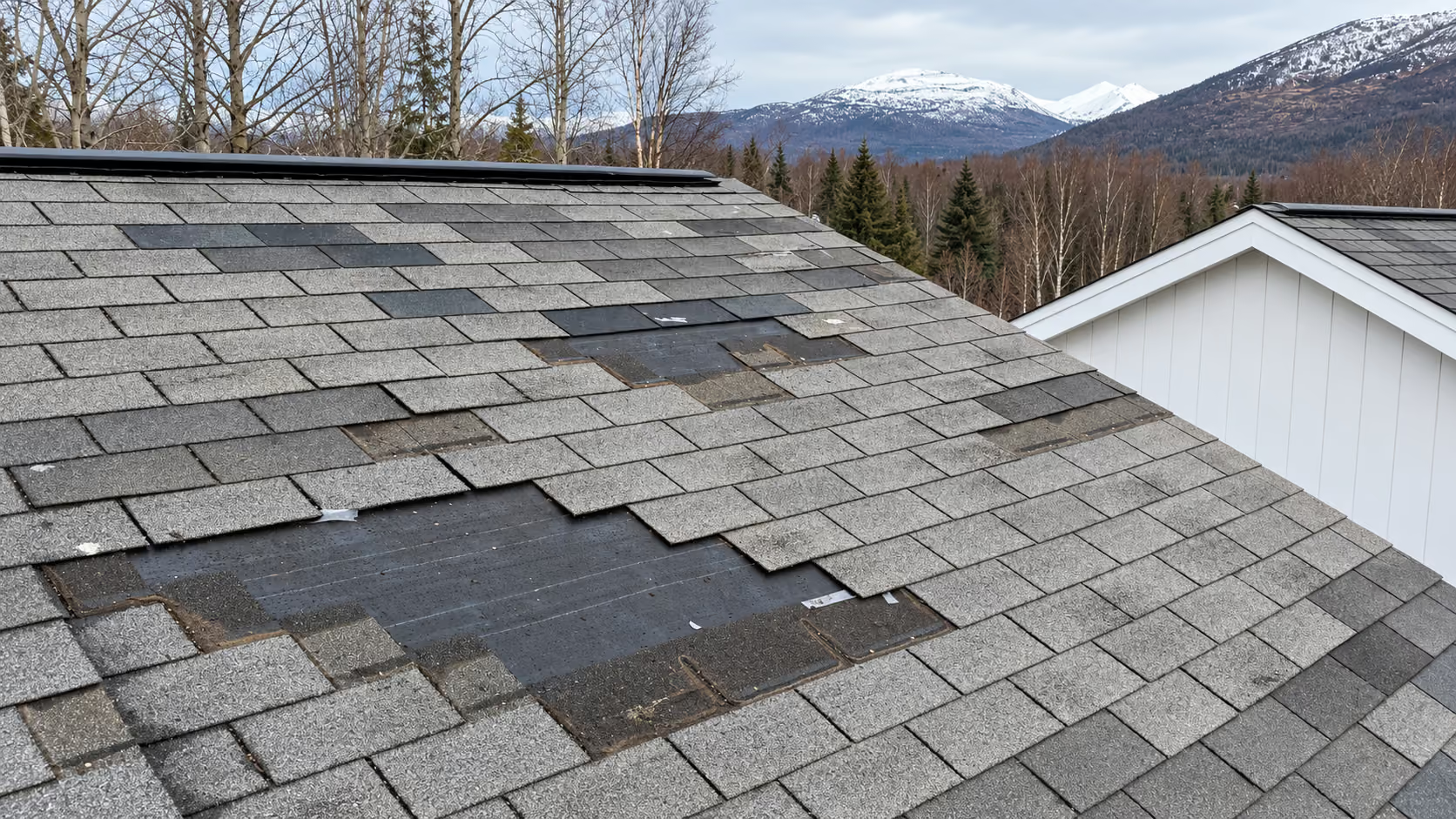
If you aren’t sure, start with a roofer. Wind damage often doesn’t show from the ground, since creased shingles lie back down looking fine. A free inspection on the roof and in the attic shows whether there’s damage worth claiming. Roof inspections →
Not sure it’s a claim?
Text photos of the damage, and a roofer will tell you what we see.
The adjuster visit
Your insurer sends an adjuster to inspect the damage and write its estimate, and the Division says you may want your own contractor there. That’s our part: we photograph the damage, write a scope that matches it, and meet the adjuster on site.
You file the claim and it stays yours, so don’t sign anything that hands it to a contractor. We don’t negotiate coverage. That’s a job for an attorney. Insurance claims →
Actual cash value vs. replacement cost
Actual cash value
The cost to repair or replace the roof, minus depreciation for age and wear. On an older roof, the check can fall well short of the cost.
Replacement cost
The full cost to repair or replace it. The insurer may pay actual cash value first, then release the rest, the recoverable depreciation, after the repairs.
The Division’s claims guide says the time limit to collect recoverable depreciation can range from six months to a year. Full replacements are scheduled around temperature and snow, so tell your adjuster if the work waits for spring.
Who pays the deductible?
You do. It’s your share of the claim. The Division’s guide says it can be "a specific dollar amount or a percentage," and some policies have a special one for wind or storms. If the repair costs less than the deductible, a claim pays nothing. Be wary of anyone who offers to cover your deductible.
Alaska’s claim timelines
Alaska’s rules, 3 AAC 26, put insurers on a clock. Working days skip weekends and federal and Alaska holidays (3 AAC 26.300).
- Acknowledge. In writing within 10 working days of your claim report, and other replies within 15 working days (3 AAC 26.040(a)).
- Investigate. Within 30 working days, or written notice by day 30 of why and how much longer (3 AAC 26.050).
- Accept or deny. In writing within 15 working days after proof of loss, unless the policy sets another limit. Taking longer requires written reasons, then updates every 45 working days (3 AAC 26.070(a)(1)).
- Pay. The undisputed part within 30 working days after proof of loss (3 AAC 26.070(a)(2)).
Your insurer can’t require notice or proof of loss by a deadline your policy doesn’t set (3 AAC 26.060(3)). Report promptly anyway.
Missed damage or a denied claim
Start with the insurer’s reason, in writing. Then:
- Send documentation. For anything the scope missed, like damage that was under snow at the first visit.
- Ask for a reinspection. A second look can settle it. We can meet the adjuster on site again.
- Use the appraisal clause. For a dispute over the amount, the Division says Alaska law requires appraisal. Each side picks and pays its own appraiser, and the two pick an umpire. Appraisal decides cost, not coverage.
- Talk to an attorney about coverage. Alaska doesn’t license public adjusters, and the Division says public adjusting "may constitute the practice of law."
- File a complaint. Try your insurer first, then the Alaska Division of Insurance’s Complaints page. "Normal complaints take approximately 45 working days to complete," the Division says.
Storms that damage roofs in Southcentral
- Chugach wind. Anchorage gusts hit 134 mph (April 4, 1980), 122 mph (February 10, 2004), and 118 mph at Glen Alps (December 3 to 4, 2011). On January 12, 2025, Bear Valley saw about 110 mph, and a Muldoon home lost part of its roof.
- Matanuska wind. Palmer’s airport hit 88 mph and Wasilla’s 74 mph on January 2, 2022. After an early December 2025 windstorm put trees on roofs, the governor declared a Mat-Su Borough disaster on December 9, and Palmer’s airport hit 90 mph on December 28.
- Snow load. Anchorage’s winter of 2023 to 2024 brought 133.3 inches, the second-snowiest on record. More than two dozen Anchorage roofs, mostly commercial, collapsed that winter and the one before.
- Falling trees. Where spruce beetles have killed trees, UAF’s extension service warns that "dead trees become an increasing hazard to structures and people."
Some storm damage only shows up close. Storm damage repair →
Storm damage? Start with a free inspection.
A photo report and a written price within 24 hours of the inspection, and no pressure after it.
Storm damage claim questions
The questions we hear most after a big wind or a heavy snow. Don’t see yours? Text us and a roofer answers.
Text my rooferIf you can see damage, like a tree through the roof, call your insurer or agent right away. Alaska’s Division of Insurance lists that as the first step. If you aren’t sure, start with a roofer: a free inspection on the roof and in the attic shows whether there’s damage worth claiming. If there is, report it promptly.
Sometimes. If wind damaged the roof badly enough, often yes. If it’s simply old, usually not, since policies generally don’t cover wear and age. Your policy and your adjuster decide, and an actual cash value policy takes depreciation off the check. We document the damage either way.
Under 3 AAC 26.070(a), after proof of loss, the insurer has 15 working days to accept or deny in writing, unless the policy sets another limit, and 30 working days to pay the undisputed part. Needing more time to decide means written reasons and updates every 45 working days.
It’s the part of a replacement cost claim held back until the work is done. The first check is actual cash value: the repair or replacement cost, minus depreciation. You can claim the rest after the repairs, within a time limit the Division’s guide says can range from six months to a year.
No. We photograph the damage, write a scope that matches it, and meet your adjuster on site. You file the claim and it stays yours. We don’t negotiate coverage. That’s a job for an attorney, and Alaska doesn’t license public adjusters.
Read the denial. Under 3 AAC 26.070(a)(1), a denial must state the specific provisions, conditions, exclusions, and facts it rests on. More documentation or a reinspection sometimes settles it. Disputes over the amount go to appraisal. Coverage disputes are a job for an attorney, or you can file a complaint with the Alaska Division of Insurance.
Let’s get the damage on record
Text photos from the ground or book an inspection. You get a photo report and a written price within 24 hours of the inspection, and no pressure after it.