How to Check a Roofer’s License in Alaska
In Alaska, a roofer can’t bid on your roof or work on it without a contractor license from the state. Here’s how to check one, and what the license, bond, and insurance do for you.
A big wind can bring a knock on the door from a roofer you’ve never heard of, ready to start today. The Alaska Division of Insurance warns that "after storms and other disasters, fraudsters and scam artists often arrive quickly." The state’s red flags for hiring a contractor include one who solicits door-to-door and one who asks you to pay for the entire job up front.
After the 2018 earthquake, Anchorage building officials warned against door-to-door solicitors too. Your first check is a license lookup, and you can do it before anyone climbs your roof or takes a deposit.
The short version
- A state contractor license. Required to bid on or work on your roof anywhere in Alaska. A business license alone doesn’t count.
- In Anchorage, a city license too. Required for construction within the Municipality of Anchorage Service Area.
- A bond and insurance. Required to register. Ask for proof that both are current.
A business license isn’t a contractor license
The state says "every construction contractor must hold a professional license and a business license." They do different jobs:
Business license
Required before engaging in business activity. On its own, it doesn’t let anyone work on your roof.
Contractor license
The licensing division calls it a professional license, the statute a registration. No one may bid or work as a contractor without it.
The state warns that some people say they’re "licensed and insured" when they only have "a business license and liability insurance," not "a professional license and a bond." Ask which license.
Which license a roofer should have
The state’s contractor types are General, General with Residential Endorsement, Specialty (up to three trades), Mechanical, Electrical, and Handyman. Roofing is a specialty trade covering "all types of roofs using all types of roofing material," so a roofing-only company holds a Specialty registration. Bond amounts:
- Specialty: $10,000. Roofing falls here.
- General: $25,000. Or $20,000 with the residential endorsement, for residential work only.
- Handyman: $5,000. Projects up to $10,000 in total, labor and materials included, and a job can’t be split to stay under. No work that needs a residential endorsement or an electrical or mechanical administrator.
General contractors need the residential endorsement to build, alter, or bid on homes of one to four units, where "alteration" means changes over 25 percent of the structure’s value. The law names only general contractors, and the state doesn’t list it for specialty contractors.
Bond and insurance requirements
To register, a contractor posts that bond and carries liability insurance of at least $20,000 for property damage, $50,000 for injury or death to one person, and $100,000 for more than one, unless every project is $2,500 or less. Workers’ compensation is required only for contractors with employees.
Both have to stay current: lapsed insurance suspends a registration, and a canceled bond revokes it. The state says to ask for "proof of their current bonding and insurance."
How to look up a roofer
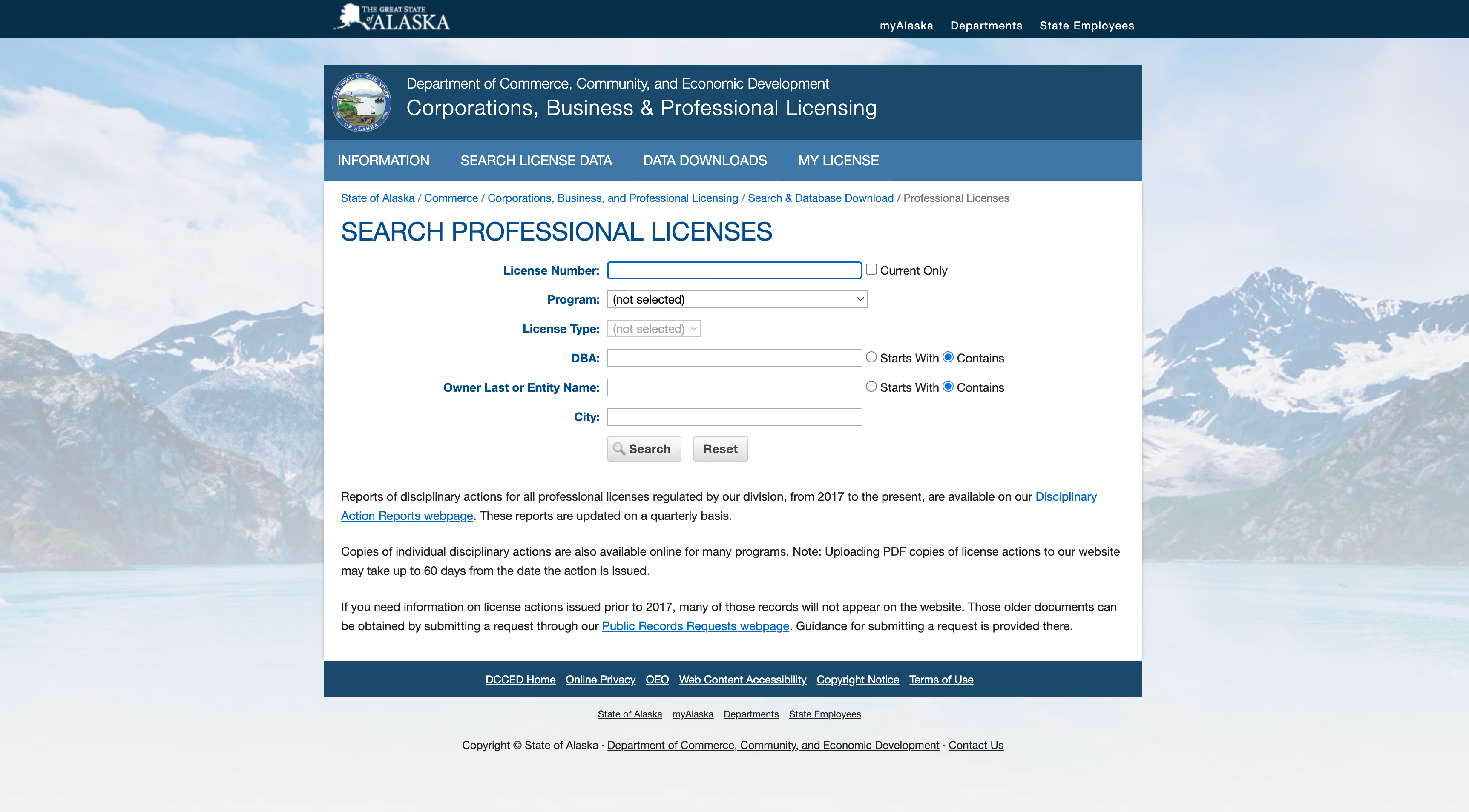
Use the state’s Professional License Search, and check the company named on the contract. The state says the details show whether the license is current, the specialty type, and any past licensing action. No current license, no signature.
Anchorage has its own contractor license
Anyone doing construction within the Municipality of Anchorage Service Area also needs a Municipal Contractors License. The city says its license "is only given after state license, insurance and necessary specialty licenses are confirmed." The city’s own contractor license search shows which license types a contractor holds, and Roofing is one of them.
What a roofer’s ads and contracts must show
Under AS 08.18.051(b), a contractor’s ads, contracts, cards, signs, and documents must show its name, mailing address, and principal place of business, and ads and contracts need the registration number. An ad can send you to a website for those details instead, if it says they’re there and the site has them. Ads also have to use the business name on the business license. No number and no address? Look harder.
Door-to-door contracts: five business days to cancel
Under AS 45.02.350, you can cancel a door-to-door contract of $10 or more within five business days, and the seller has to give you written notice of that right at the sale. Emergency work you called for yourself is excluded. To cancel, mail the seller a registered letter, return receipt requested, and keep a copy.
If the wind did damage your roof, here’s how we handle it. Storm damage repair →
Got a quote at the door?
Text us a photo and a roofer will tell you what we see.
How to claim against a contractor’s bond
A bond claim is a lawsuit in district court. The statute also has you mail the complaint to the state, with two copies and a fee going to the Division of Insurance, which serves the bonding company.
The bond pays what a court awards for "negligent or improper work or breach of contract," up to the bond amount. If claims exceed it, labor, taxes, and materials are paid before breach of contract. A defect claim on your home needs written notice at least 90 days before you file. Talk to an attorney first.
Before you sign: a checklist
- Look up the state license. Current, and in the name on the contract.
- In Anchorage, check the city license. Use the Municipality’s contractor search.
- Ask for proof of bond and insurance. Both should be current.
- Read the paperwork. Registration number, mailing address, business address.
- Get it in writing. "Oral promises are very difficult to enforce," the state says.
- Don’t pay the whole job up front. The state calls it a red flag.
- Signed at your door? You generally have five business days to cancel.
Comparing bids on a roof replacement? See what goes into the price. Roof replacement cost →
Fortress Roofing is licensed and insured in Alaska, contractor license AK #260001. You can look it up on the state’s Professional License Search. Licensing and insurance →
Start with a free inspection.
A photo report and a written price within 24 hours of the inspection.
Questions about roofer licenses
The questions we hear most about checking a roofer in Alaska. Don’t see yours? Text us and a roofer answers.
Text my rooferUse the state’s Professional License Search. The state says the details show whether the contractor’s license is current, the specialty type, and any past licensing action. A business license alone isn’t enough. Inside the Municipality of Anchorage Service Area, check the city’s contractor license search too.
It should mean a state contractor license plus liability insurance, and registering also takes a bond. The state warns that some people say "licensed and insured" when they only have a business license and liability insurance, not a professional license and a bond. Look up the license and ask for proof of the bond and insurance.
Yes, two contractor licenses. Every contractor in Alaska needs a state contractor license, and construction within the Municipality of Anchorage Service Area also takes a Municipal Contractors License. The city says it issues that license only after confirming the state license, insurance, and any specialty licenses. Its search covers license types, Roofing included.
Generally, yes. Under AS 45.02.350, a door-to-door contract of $10 or more can be canceled within five business days, and the seller has to give you written notice of that right at the sale. Emergency work you called for yourself is excluded. Cancel by registered letter, return receipt requested, and keep a copy.
It pays what a court awards against the contractor for negligent or improper work or breach of contract, up to the bond amount: $10,000 for a specialty contractor, $20,000 or $25,000 for a general contractor. You collect by suing on the bond in district court. If claims exceed the bond, labor, taxes, and materials are paid first.
Liability insurance of at least $20,000 for property damage, $50,000 for injury or death to one person, and $100,000 for more than one, unless every project is $2,500 or less. Workers’ compensation is required only for contractors with employees. Lapsed insurance suspends the registration, so ask for proof it’s current.
Get a written price before anyone starts
Text a photo or book a free inspection. You get a photo report and a written price within 24 hours of the inspection, and no pressure after it.